
When Increasing Ad Spend Stops Making Sense
Spending more is the fastest thing a marketing team can do, which is exactly why it gets chosen when something needs to happen this quarter. It works until it does not, and the point where it stops working is usually visible in advance.
On this page
There is a stage in most growing stores where paid acquisition genuinely is the answer. The product converts, the unit economics hold, and the only limit is how many people have seen it. Adding budget there is not lazy thinking. It is the correct move.
The trouble is that the same move keeps getting made after the conditions that justified it have gone.
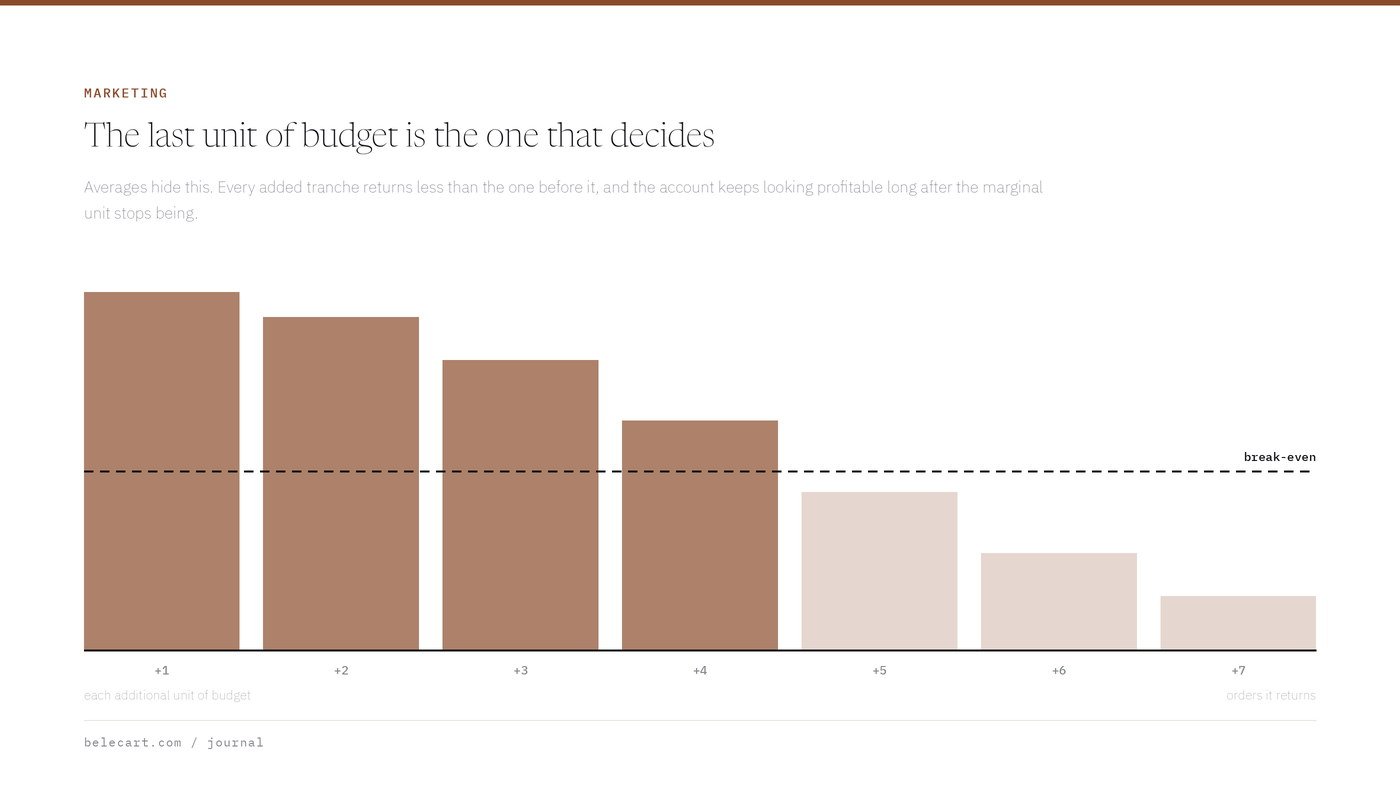
Ad spend does not scale linearly
The first thousand you spend reaches the people most likely to buy. Platforms are built to do that, and they do it well. The next thousand reaches people slightly less likely to buy. This continues, and the cost of each additional customer climbs.
The curve is not a straight line and it is not a cliff. It bends. Doubling the budget might produce sixty percent more orders, which can still be a good trade depending on margin, or it might produce fifteen percent more, which is not.
Most teams never measure the bend. They compare this month’s cost per acquisition to last month’s and treat the difference as performance. If spend also changed, that comparison is measuring two things at once.
The useful habit is to record cost per acquisition at each spend level you have actually run, over enough weeks to be meaningful. After a few months you have your own curve rather than a theory about one.

Saturation looks like fatigue
When results decline, the standard diagnosis is creative fatigue and the standard response is new creative. Sometimes that is right. New assets lift performance and the campaign continues.
Sometimes the audience is simply finished. Everyone in the reachable segment who was going to respond has responded, and the new creative reaches the same exhausted pool wearing a different outfit. Performance recovers for a week from novelty, then returns to where it was.
Frequency helps distinguish the two. Rising frequency with falling response points at audience exhaustion. Flat frequency with falling response points at the creative or the offer.
Saturation is not a failure. It means you have covered a market. The response is to find a different audience, a different channel, or a different reason for the same audience to buy again, none of which is achieved by raising the daily cap.
The landing page sets a ceiling
Paid traffic is bounded above by what happens after the click. A campaign cannot outperform the page it points at, and a page that converts poorly imposes a hard limit on how much you can profitably spend.
This is where I find the most upside in stalled accounts, and it is consistently the least popular place to look, because changing the page requires someone outside the marketing team.
Two specific mismatches show up repeatedly. The ad promises something the page does not immediately confirm, so the visitor has to hunt for the thing that made her click. And the ad targets a specific need while the page is a generic category listing, which pushes the work of finding the right product back onto the customer.
Improving conversion on the page raises the whole curve. Every level of spend gets cheaper per order at once, which is a different kind of gain from optimising the bidding.
Profit, not revenue
Ad platforms report revenue, because revenue is what they can see. The decision needs contribution margin, which they cannot.
Take a $60 order with 40 percent contribution margin after product cost, payment fees and shipping. There is $24 available. At a $20 acquisition cost the order contributes $4 before overhead. At $26 it loses money, while the platform dashboard reports a return on ad spend above two and looks entirely healthy.
Teams operating on revenue-based targets can scale their way into losses with every metric green. I have seen accounts where the most efficient action available was to cut spend by a third and keep the same profit with less working capital tied up.
The fix is unglamorous. Get the real margin by product category, feed it into the target, and stop reporting return on ad spend as if it were profit.
Retention changes the arithmetic
Everything above assumes a single purchase. If customers come back, the ceiling on acquisition cost rises, sometimes dramatically, and campaigns that look unprofitable on first order become sensible.
This is the honest argument for tolerating a high CAC, and it is also the most abused one. It only holds if repeat purchase is measured rather than assumed. A projection built on an aspirational retention rate will justify any budget.
The order of operations matters. Improve retention first, then use the improved economics to buy more aggressively. Doing it the other way round means acquiring a larger group of customers who behave exactly like the last group.
There is also a quieter effect. Spending more on acquisition usually reaches people with weaker intent, and weaker intent tends to produce weaker retention. The customers bought at the margin are often not comparable to the ones bought earlier, so the blended lifetime value drifts down as spend rises.
Signals that more budget will not help
The pattern is usually visible before the quarter ends.
- Cost per acquisition rises steadily as spend rises, and does not recover when creative is refreshed.
- Frequency climbs while click-through and conversion drift down together.
- Branded search volume is flat, which suggests the spend is not building demand, only harvesting it.
- Return on ad spend holds up but contribution margin per order is falling, usually through discounting.
- New customer count grows while repeat rate for recent cohorts declines.
- The share of orders from the cheapest campaign keeps shrinking as budget moves to worse ones.
Any one of these on its own can have another explanation. Three of them together is a curve that has bent.
What I do instead
When the account is at that point, the options are less exciting than a budget increase and usually worth more.
Work on the page and the offer, because that lifts every level of spend at once. Reduce the number of steps between the ad and the thing the ad promised. Look at whether the product mix being advertised is the mix with the best margin, which is often not the mix with the best click-through.
Build something that acquires customers without a per-click cost. Email, search, community and referral are slower and do not stop working when the card is declined.
Then look at the customers already in the database. A store spending heavily on acquisition while sending two campaigns a month to existing buyers is buying strangers at a premium and ignoring people who already trust it.
None of this argues against paid acquisition. It argues against treating budget as the only lever, which is what happens when it is the only lever the marketing team controls directly.